


Australia Only Compete Once the Match Is Lost
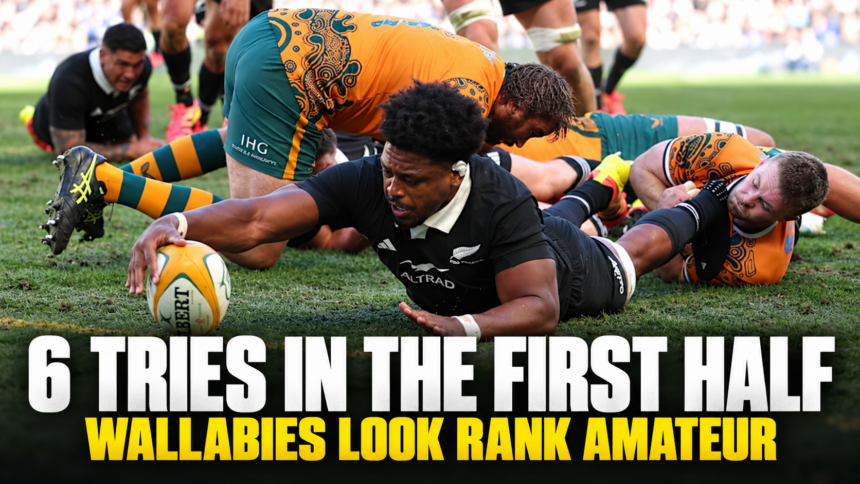
New Zealand scored six first-half tries in Sydney, a week after scoring 50 in Auckland. A year before Australia host the World Cup, the gap to the best team is now measured in tries per half, and the late rally is hiding it.
New Zealand won 43–21 at Accor Stadium. The final score says the All Blacks were 22 points better. That figure is the least accurate part of the afternoon.
The real gap was 36 points. That was the margin when Josh Moorby scored his second try soon after the restart and made it 43–7. New Zealand had scored seven tries to one. The Test was settled with almost 40 minutes still to play. Everything after that was played under different conditions: no pressure, no expectation and nothing to lose.
This is what Australia must face. They did not lose a close Test. They lost a one-sided one, then played their best rugby once the result no longer depended on it.

A pattern, not a lapse
Take any single result out of context and it can be called an off day. These results cannot.
Seven days earlier, New Zealand beat Australia 50–19 at Eden Park. Over the two Tests, Australia conceded 93 points and scored 40. That is an average of 46.5 points conceded per Test against the team they must beat to win a World Cup. A team that concedes almost a point every two minutes for 160 minutes has a structural problem, not a selection problem.
The defeat in Sydney mattered more than the one in Auckland because of what came between them. Australia had been warned. They had a week, home conditions and a crowd, and the failures were already identified. Then they conceded six tries before half-time. They had already seen the problem, so the issue in Sydney was fixing it, and they could not.

How a defence comes apart
Six tries in a half is not six separate mistakes. It is one failure happening over and over.
When a defender is a fraction late, the next defender has to move in to cover. That leaves space further out. New Zealand understand this sequence better than anyone. With Cam Roigard moving the ball quickly, Wallace Sititi taking defenders over the gain line, and Damian McKenzie and Beauden Barrett both able to direct the attack, the All Blacks kept arriving at the moment Australia were still adjusting their line.
Australia were not beaten by individual brilliance. They were beaten by timing. Every time they reacted, the play had already moved on. Jeremy Williams’ try gave the home crowd a moment to cheer. It did not stop the pattern.
By half-time it was 36–7. New Zealand could have conceded five unconverted tries and still been in front.
The detail that should worry Australia most
McKenzie converted four of New Zealand’s seven tries, missing three kicks and leaving six points on the field. Australia converted all three of their tries.
Australia were better from the kicking tee and still lost by 22. Goal-kicking is usually what decides close Tests. It made no difference here, because this was not a close Test. New Zealand won by scoring more tries, and that is the hardest kind of advantage to close quickly.

Why the rally should not reassure anyone
It is easy to praise a team for scoring the last 14 points. Australia showed resilience, and a side that stops working at 43–7 can lose by 60. But that rally should not be taken as evidence of improvement.
Two-thirds of Australia’s points came after New Zealand had built a 36-point lead. In other words, Australia attacked well only after the opposition’s need to defend had largely disappeared. That says little about whether the Wallabies can perform when the result is still at stake, which is the only situation that counts in knockout rugby.
Les Kiss needs to ask why his team play their best rugby once they have nothing to lose. A team that only shows up when expectations have collapsed is not ready to win big matches.
The fly-half is not the explanation
Declan Meredith had a difficult afternoon, and he will be the easiest player to blame. It would be the wrong conclusion.
A young fly-half depends on the players around him. He needs quick ball from the breakdown. He needs runners who are in position before he decides where to pass. He needs a kick chase organised enough to put pressure on the catcher. When none of that is in place, the fly-half looks worst simply because every decision goes through him.
Australia’s problems are breakdown speed, defensive spacing and accurate kicking, and they belong to the whole team. Talk of pride and response will not fix them. Only better execution will.
What a home World Cup is worth
Australia host the 2027 Rugby World Cup. A home tournament gives the national game its best chance in a generation to win new supporters, attract new commercial partners and build broadcast value. That depends on the host nation being competitive against the best. A big crowd will turn up regardless. Whether people still care in 2031 depends on whether Australia give them reasons to believe in 2027.
Familiar grounds and a home crowd will not fix a defensive line that cannot stay connected. A home tournament can make people want to watch, but only performances keep them watching.
Australia still have time. One result in October does not decide a tournament a year away. But the standard is now plain: Australia must become hard to score against while the match is still undecided. Until they do, their attacking players will keep producing late rallies that make the score look closer than the match was.