

27 Oct 2026 · @Mark John
Isuzu has bought a working showroom. Woolworths has bought the checkout. Brands still paying for impressions at Rugby World Cup 2027 are about to learn what that costs them.
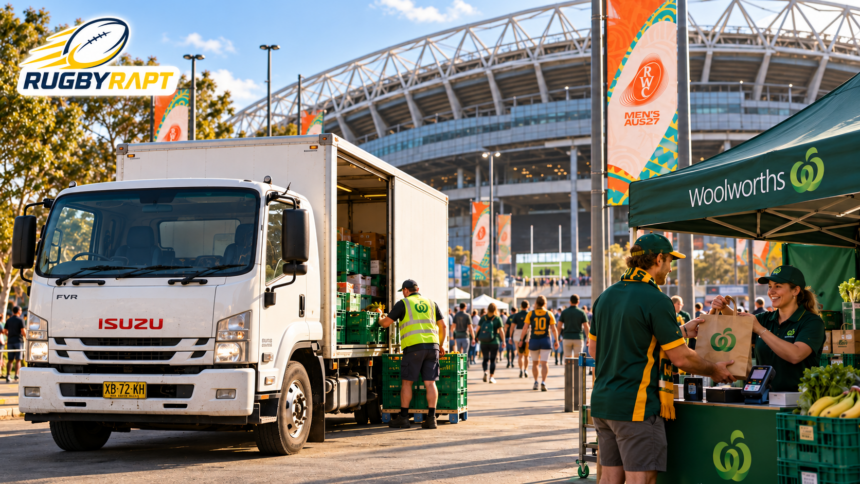
In the space of 48 hours last week, World Rugby added two names to its Australia roster. On 20 October, Woolworths was confirmed as Official Supermarket Supporter of the men’s Rugby World Cup 2027 and the women’s tournament in 2029. On 21 October, Isuzu Motors was named Official Automotive Partner of the same pair of events.
Neither name grabs headlines the way an airline or a global bank would. Both deals matter more than that. Read the terms closely and the product World Rugby is selling has changed. It is no longer category exclusivity and perimeter boards. It is access to operations, customers and the moment of purchase.
What Isuzu is actually buying
Isuzu makes commercial vehicles, and its deal reads like it. The company and the tournament are exploring transport for participating teams and the tournament workforce, backed by more than 160 Isuzu outlets across Australia. Fan activation at venues and host-city Fan Festivals sits alongside that.
The timing is deliberate. 2027 marks Isuzu’s 90th anniversary, and chief executive Naohiro Yamaguchi has framed the partnership as a global stage for the company’s transformation into a commercial mobility solutions business.
That is the tell. Isuzu is not paying for awareness among rugby supporters, most of whom will never buy a truck. It is paying for a six-week, 52-match operational proof point in front of fleet buyers, logistics directors and public-sector procurement teams. If its vehicles move squads and staff across seven host cities without incident, the case study sells itself. If they fail, the failure is just as public. Isuzu has signed up for that asymmetry with its eyes open.
Woolworths has sold its customers, not its shelves
The Woolworths deal is the more consequential of the two because of what sits inside it. The partnership incorporates Cartology, Woolworths Group’s retail media business. Supplier brands and FMCG advertisers will be able to run tournament-linked campaigns across digital, in-store and point-of-sale channels throughout both tournament cycles.

Scale is the point. Cartology reports roughly 82.7 million Woolworths transactions a month and more than 11 million active Everyday Rewards members. That is first-party purchase data tied to identifiable households, now wired into the biggest rugby event the southern hemisphere will stage this decade.
The economics invert the traditional sponsorship model. Woolworths pays the rights fee. Its suppliers, from sauce and snack makers to meat processors chasing game-day barbecue spend, then pay Woolworths to activate around the tournament through Cartology. The rights become a product Woolworths resells. Run well, a line that once sat in the marketing budget as a cost starts to generate margin.
A note for South African readers: this is Woolworths Group of Australia, not the South African retailer that shares the name. They are separate companies.
Platforms, not categories
For three decades the sponsorship model was simple. A rights-holder carved its inventory into exclusive categories and sold each one to the highest bidder. The sponsor bought visibility and the right to call itself official.
That model is under strain because visibility is cheap and proof is expensive. A perimeter board cannot show that it sold anything. A retail media network can, which is why advertisers keep moving money towards channels that sit beside the point of purchase.
On the evidence of these two deals, World Rugby is selling partners something they can use rather than something they can only display. Isuzu gets an operational role. Woolworths gets a connection between watching and buying that it can charge others to use. Both join an Australia 2027 roster that already carries Emirates, Asahi Super Dry, Visa, LIQUI MOLY and Coca-Cola.

The cost falls on everyone outside the tent. When the official supermarket controls the in-store and digital channels nearest the shopper, an unofficial food or drink brand loses more than the right to a logo. It loses its most efficient route to the customer for the length of the tournament. Exclusivity is migrating from the stadium to the shopping basket.
The Springbok supporter is still unclaimed
The Springboks arrive in Australia as defending champions, opening against Italy at Adelaide Oval on 3 October 2027. Their travelling support is a valuable audience, and neither of last week’s deals is built to reach it.
Woolworths’ retail media network targets shoppers in Australia and New Zealand. Isuzu’s activation runs through its Australian dealer footprint. The supporter flying out from Johannesburg or Cape Town sits outside both.
That supporter makes most of the important purchases at home, in rand, weeks before kick-off: flights, travel insurance, foreign exchange, roaming data, accommodation. They consume rugby content for months before that. None of those transactions pass through an Australian supermarket’s media network.
The South African brands that win this window will not be the ones that mimic official sponsors. Tournament marks are tightly protected, and any campaign implying association with the event should be cleared by lawyers first. The winners will serve the supporter’s journey on its own terms, through travel and money products, supporter content and digital media targeted at South African audiences. None of that needs a World Rugby rights fee. All of it needs an offer whose take-up can be counted.
What every rights-holder should take from this
The lesson reaches well beyond Australia. Every rights-holder in rugby, from World Rugby down to provincial unions and franchise clubs, holds the same raw assets: an audience with intent, and predictable moments when that audience spends.
Those that package those moments as transactions, with redemptions and registrations a partner can count, will command the higher fees. Those still selling square metres of advertising board will end up competing on price.
Isuzu and Woolworths have each paid for a measurable outcome. The rest of rugby’s commercial market should expect to be asked for the same.