


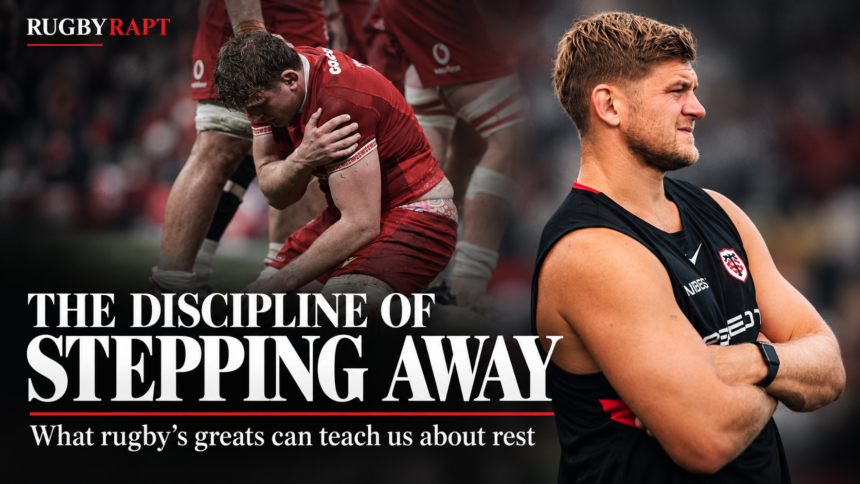
Jack Willis has described the frustration of watching Toulouse from the sidelines: the missed opportunities to contribute, the setbacks in rehabilitation, and the disruption of routines that help him feel mentally settled. His account also contains a valuable admission. Time away has allowed the rest of his body to recover and offered space for interests beyond rugby.
For a professional whose working life revolves around competition, accepting that space can be difficult. Selection offers tangible proof of usefulness. Rehabilitation demands patience while somebody else wears the shirt. Yet rugby offers compelling examples of outstanding players who deliberately stepped away in pursuit of excellence.
Richie McCaw provides one of the clearest. In 2013, the All Blacks captain took an extended sabbatical, missing the entire regular Super Rugby season before returning for the Crusaders in the knockout rounds. The objective was explicit: give his body time and extend his career towards the 2015 World Cup.
Two years later, he captained New Zealand to another world title. That sequence does not prove the break caused the victory. It does establish that a substantial absence from competition was compatible with returning to the highest level and leading the best team in the world.
Dan Carter followed a similar course. After the November 2013 internationals, he announced a planned six-month sabbatical, saying he wanted to address persistent injuries and prepare physically and mentally for the next World Cup. His coaches supported the decision despite losing an exceptional player.

The outcome was emphatic. In the 2015 final, Carter scored 19 points against Australia and was named man of the match. He also won World Rugby’s player of the year award. At 33, he delivered a defining performance after a career that had required careful interruption.
But Carter’s story also exposes the limits of any easy recovery narrative. After his sabbatical, he broke his leg in the 2014 Super Rugby final. Rest had not made him immune to injury. His eventual success required further rehabilitation; there was no uninterrupted ascent from holiday to silverware.
The wider injury evidence explains why these decisions matter. A study published in the British Journal of Sports Medicine examined 16 seasons of English professional men’s rugby, spanning 2002/03 to 2018/19. Researchers recorded 10,851 match injuries across 124,952 player-hours, with an average of 57 injuries per club per season.

The overall incidence was 87 injuries per 1,000 player-hours, and each injury caused an average absence of 25 days. These are injury events, not 10,851 different players: the same individual can be injured repeatedly. Nor should this historical English dataset be presented as a current global injury count.
The tackle accounted for 43 per cent of injuries. Over the study period, injury incidence remained broadly stable, but average injury severity increased. That distinction matters: the burden can worsen because injuries remove players for longer, even without a rising frequency.
World Rugby’s October 2025 workload guidelines recognised the need for protected recovery. They recommended no more than 30 full games in a season or six consecutive match weeks, alongside a dedicated five-week offseason break and 12 weeks without contact across the year. Non-contact time does not mean complete inactivity.
Those guidelines draw on scientific evidence and, where research is absent, expert opinion. They are a framework for managing exposure, not a guarantee against injury or proof that every player needs an identical programme.
Willis’s enforced absence also differs from a planned sabbatical. He is describing rehabilitation, with its uncertainties, rather than choosing a convenient pause. His observation about outside interests deserves attention on its own terms: rugby can remain central to a player’s life without occupying every available corner.
The lesson for clubs is to make recovery possible before exhaustion or injury forces the decision. That requires squad depth, coordination and the willingness to select somebody else.

For supporters, it requires a broader understanding of commitment. McCaw and Carter showed that ambition could accommodate absence. Willis is describing the patience demanded when absence arrives uninvited.
The player who wants to give everything on Saturday must also be allowed the time he needs away from it. A career deserves to be judged across seasons, with room for the weeks spent rebuilding both physically and mentally.