

Round 3 of the BKT United Rugby Championship did not merely supply results. It exposed ambitions, interrogated balance sheets, and reminded a sport increasingly obsessed with celebrity squads that cohesion remains rugby’s most valuable currency.
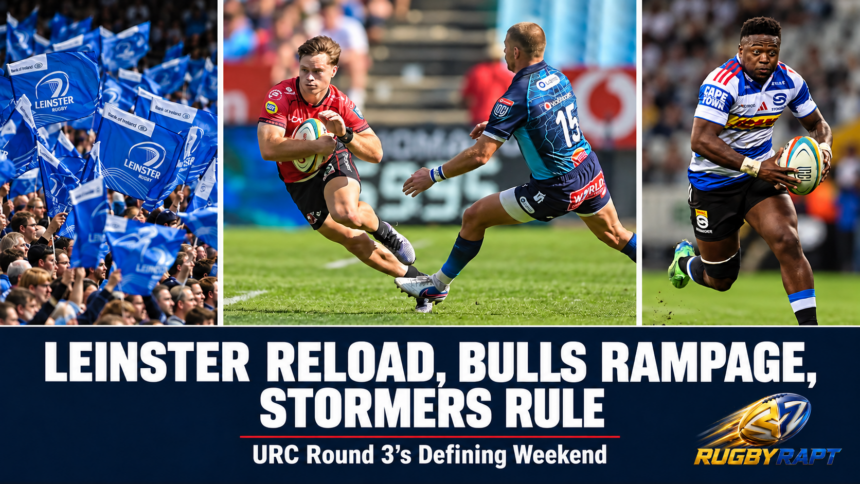
Leinster’s 29–5 dismantling of Cardiff at the Laya Arena was the weekend’s most clinical statement. This was not a performance built on spectacle; it was an exercise in institutional muscle memory—set-piece control, territorial suffocation, and the quiet cruelty of a squad that treats depth as a weapon rather than a compromise. Leo Cullen’s side had arrived searching for their first win of the season; they left having restored the sport’s most familiar hierarchy.
Yet Dublin did not own the conversation. Cape Town did.
Stormers 39, Sharks 22: The Reckoning
The Stormers’ 39–22 destruction of the Sharks at DHL Stadium was the fixture that detonated across social platforms, forums and group chats from Cape Town to Cardiff. It was not simply a derby. It was an ideological collision: the Sharks’ assembled galaxy of Test-calibre talent against John Dobson’s Stormers, a team built on pressure, connectedness and the unglamorous violence of the breakdown.
The Sharks came expecting to impose their star power. Instead, they were out-run, out-thought and out-fought in the phases that decide modern rugby. Sacha Feinberg-Mngomezulu steered the Stormers with a try and a commanding kicking performance, while the hosts turned transition into a weapon and made every Sharks error feel like an invitation.
This result ended the Sharks’ unbeaten start and raised the question their supporters have been trying to avoid: what, precisely, is the return on investment when a roster overflowing with Springbok pedigree cannot survive a derby played at championship tempo? Talent buys attention. Structure wins Saturdays. The Stormers did not merely beat a rival; they made a case that rugby’s future belongs to teams who defend connectedly, counter ruthlessly and refuse to surrender the emotional high ground.
Ulster 26, Munster 26: The Beautiful Stalemate
If Cape Town supplied the fireworks, Belfast delivered the purest rugby drama. Ulster and Munster’s 26–26 draw at Affidea Stadium was an interprovincial war of attrition—momentum swinging, margins microscopic, and the final quarter carrying the tension of a knockout tie.
Neither side could land the killing blow, and that was the point. This was old-school Irish rugby: bruising collisions, tactical chess, bench management under scrutiny, and two teams refusing to blink. Ulster remain without a win but continue to collect points; Munster, fresh from their 26–22 victory over the Bulls at Thomond Park, will view the draw as both a missed opportunity and further proof of their resilience.

Bulls Issue a Warning
And then there was Loftus Versfeld, where the Bulls produced the weekend’s most frightening scoreline: 57–15 against the Lions. Eight tries, relentless physicality, and a statement of territorial intent that should concern every contender in this championship. Cameron Hanekom spearheaded the demolition, and the Bulls looked less like a side rebuilding than a machine recalibrating for another title assault.
Elsewhere, Glasgow Warriors handled Connacht 36–19 at Scotstoun with the efficiency of a side that knows exactly what it is, while the Ospreys’ 38–31 victory over the Dragons at Rodney Parade delivered Welsh rugby’s signature contradiction: extraordinary entertainment, fragile defence. Scarlets’ 27–26 escape against Benetton completed a round in which mid-table survival was decided by the width of a post.
The URC’s Real Growth Engine
Here is the uncomfortable truth for the league’s traditional power centres: the South African derbies have become the URC’s commercial and cultural engine. Cape Town did not just produce a result—it produced an argument, a villain narrative, a tactical controversy and a week’s worth of content.
Leinster remain the operational benchmark. Ireland remains the championship’s strategic heart. But the Stormers have just demonstrated something more marketable: rugby as theatre, rivalry as fuel, and a home crowd capable of turning a league fixture into a global event.
The Stormers did not only beat the Sharks. For seven days at least, they owned European rugby’s conversation.