

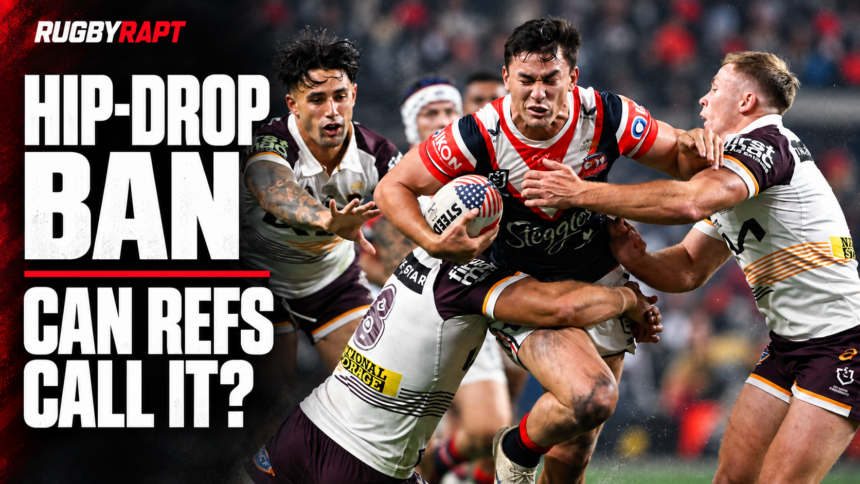
World Rugby has expanded its player-welfare mandate beyond head contact and concussion. Under a major amendment to Law 9.13 (Dangerous Play), knee-drop tackles are prohibited immediately, with hip-drop tackles set for enforcement from 1 November 2026.
The regulatory drive is straightforward. Catastrophic lower-limb injuries—syndesmosis tears, fractured fibulas, and severe ankle dislocations—have surged across collision sports. Severe injuries to Australian players Max Jorgensen and Treyvon Pritchard demonstrate the structural damage caused by this technique. When a defender wraps a carrier from behind and drops their full body weight directly onto the back of the legs, extreme torque transfers into fixed joints.
Yet, as World Rugby targets this mechanical hazard, the operational reality falls squarely on match officials. The critical question for the game is not whether the technique is dangerous—it unquestionably is—but whether referees and TMOs can accurately identify it at full speed without causing officiating gridlock.
The Mechanics: Legal Pursuit vs. Prohibited Action
To understand the enforcement challenge, one must separate a routine pursuit tackle from an outlawed hip-drop.
- The Prohibited Hip-Drop: Requires three sequential mechanics: the defender grips or wraps the carrier (typically around the waist or upper thighs); the defender unweights themselves by swinging their hips and dropping their body mass; and the defender lands directly onto the carrier’s lower legs, trapping the ankles or calves beneath their weight.
- The Legal Alternative: A defender tracking from behind wraps the carrier and either drives through contact or slides down the body to the deck, allowing their own momentum—and the carrier’s feet—to move freely.
The mechanical boundary between these two outcomes is millimetric and calculated in milliseconds.

The Good, The Bad, and The Ugly
The Good: Eliminating Non-Evadable Trauma
The law change targets a technique where ball-carriers are entirely vulnerable. Unlike front-on collisions, a carrier pulled down from behind with feet anchored to the turf has zero ability to brace or mitigate force. Removing this action protects high-value athletic talent from career-altering lower-leg trauma and aligns rugby union with precedents set by the NRL and NFL.
The Bad: Cognitive Overload on Match Officials
Referees already arbitrate head-contact frameworks, passive versus dominant collisions, crocodile rolls, seatbelt tackles, and razor-thin offside lines. Adding another subjective assessment taxes an already overburdened officiating system.
Distinguishing a deliberate hip-drop from a tackle where a defender simply slips, gets dragged down by a heavier carrier, or collapses due to dynamic momentum shifts requires real-time forensic precision. Referees will inevitably penalize legal defensive scrambling when the final visual frame looks awkward.

The Ugly: TMO Intrusion and Fan Alienation
Expect broadcast coverage to suffer. The Television Match Official will inevitably halt match flow to run slow-motion frame-by-frame reviews. At 0.25x speed, every chasing tackle where a defender falls near a carrier’s heels appears sinister.
Sanctioning incidental contact with yellow or red cards will frustrate players, coaches, and spectators alike. The casual audience already struggles with the complexity of modern breakdown law; adding another layer of micro-adjudication risks making the sport unwatchable for non-purists.
Tactical Realignment: How Far Are We Going?
This intervention reshapes how edge defenders and scrambling back-rowers complete tackles from behind. Defenders can no longer use deadweight to bring down larger carriers in space. Tackle technique must shift entirely toward low wrap-and-roll mechanics or driving through contact with active feet.
World Rugby is right to address catastrophic ankle and leg loading. However, without clear operational thresholds that prevent over-zealous TMO intervention, the game risks trading lower-limb injuries for officiating paralysis. Protecting players is mandatory; ensuring the sport remains a fluid, coherent contest is the hard part that begins now.