


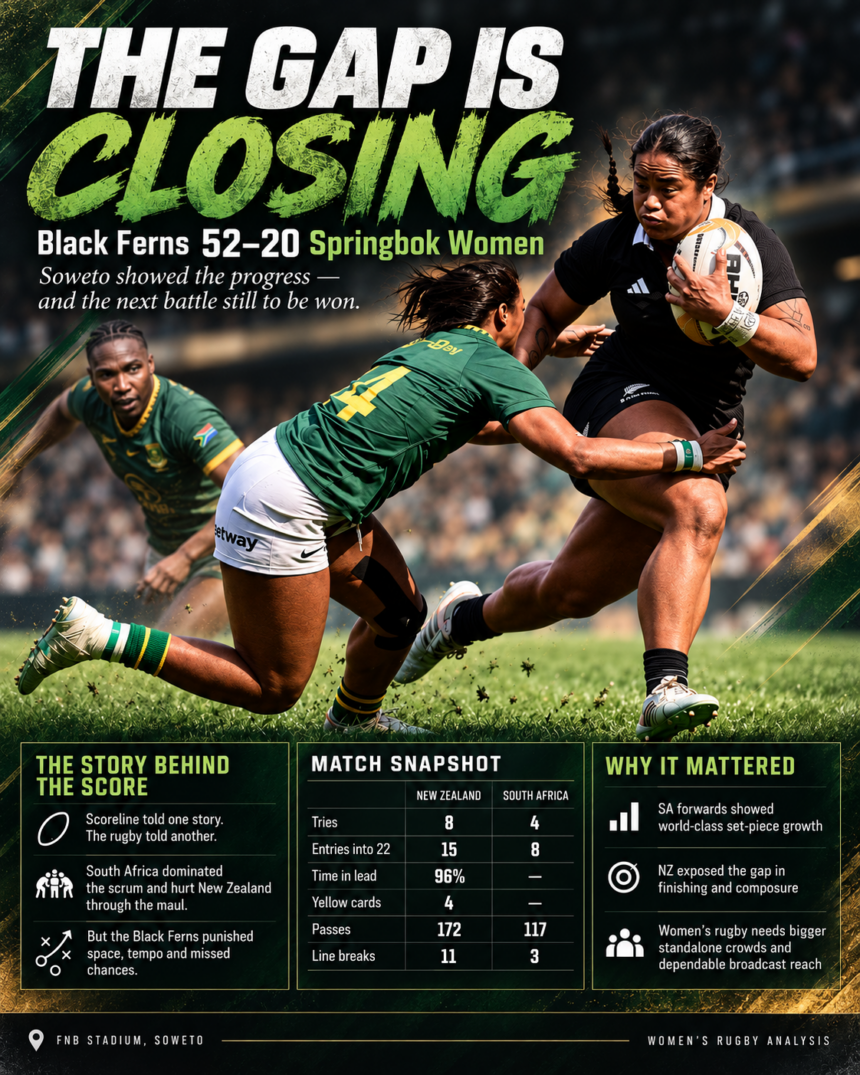
Black Ferns 52, Springbok Women 20: the scoreboard told one story at FNB Stadium. The rugby, the crowd and the broadcast told a far more important one.
There is a danger in looking at New Zealand 52, South Africa 20 and concluding that little has changed. That would be a serious misreading of what happened at FNB Stadium.
The Black Ferns scored eight tries to four, led from virtually start to finish and accumulated 15 entries into South Africa’s 22 compared with eight by the hosts. New Zealand spent 96% of the match in the lead. Yet beneath those numbers was evidence that the Springbok Women are developing something increasingly recognisable: a South African rugby identity capable of troubling the world’s best.
South Africa destroyed New Zealand at scrum time and repeatedly hurt them through the driving maul. Sanelisiwe Charlie, Lindelwa Gwala and captain Babalwa Latsha gave the Black Ferns problems that a world number two side would not have anticipated. Independent reports were emphatic about the dominance of the South African scrum.
This was only the third full Test between the countries. New Zealand won 55-3 in 2010, then 46-17 in the 2025 World Cup quarter-final and now 52-20 in Soweto. The latest score therefore does not demonstrate a straight-line narrowing of the gap. In fact, the margin increased slightly from the World Cup.

But South Africa scored four tries and created periods in which New Zealand were genuinely uncomfortable.
The crucial problem was conversion of pressure into points.
New Zealand received an extraordinary four yellow cards. At one stage the Black Ferns were reduced to 13 players — and somehow it was New Zealand who scored while two players short. That sequence may have revealed more about the distance South Africa still have to travel than the final 32-point margin.

A top-five side turns that numerical advantage into perhaps 14 points. South Africa instead surrendered momentum.
Their defence also remains vulnerable once opposition attacks escape the forward channels. New Zealand’s movement, passing tempo and ability to attack fractured defensive lines created repeated problems. The Black Ferns generated 172 passes against South Africa’s 117 and reportedly produced 11 line breaks to three.
The standout: Elinor-Plum King
If one player encapsulated the difference, it was Elinor-Plum King.
The New Zealand loose forward scored twice and was named player of the match. Her second try was particularly revealing: with New Zealand attacking quickly, King hit a line that split South Africa’s defence before finishing from around 15 metres.
Braxton Sorensen-McGee deserves almost equal billing. She scored twice and finished with 20 points, continuing her emergence as one of the most dangerous young players in international women’s rugby.
For South Africa, Vainah Ubisi’s two tries and the forward pack’s collective performance provided considerable encouragement. Byrhandré Dolf also produced important defensive interventions, although South Africa’s failure to convert any of their four tries left eight points unused.

But what was the crowd really like?
This is where the story becomes more complicated.
FNB Stadium is an extraordinary stage and was described by New Zealand Rugby as the largest venue ever to host a women’s rugby international. Match reports subsequently referred to a “good” or “energetic” crowd.
But one report from inside the stadium estimated that around 2,000 spectators were present early for the women’s international. The crowd was still building ahead of the Springboks-All Blacks Test, which eventually attracted almost 86,000.
That distinction matters.
Putting women’s rugby inside major double-headers is an excellent growth strategy because it exposes players to audiences, stadiums and production environments that would otherwise be difficult to generate independently.
But the next stage must be turning those spectators into people who arrive specifically to watch the women.
The broadcast picture tells the same story
Distribution looked impressive on paper. The match was live on SuperSport, available free through SABC Plus in South Africa, shown by Sky Sports in Britain, Sky Sport in New Zealand and Stan Sport in Australia.
But accessibility was not completely seamless.
Comments on the RugbyPass match centre complained that a promised US stream was unavailable, while a South African viewer criticised the cost of accessing SuperSport through premium DStv packages.
There is no reliable published audience figure yet for this particular Test, so claims of a television-record audience would be premature.
The wider trajectory, however, is unmistakable.
During the 2025 World Cup, more than 1.27 million unique viewers watched Springbok Women content on SuperSport, representing 334% growth from 2024, while overall consumption increased 673%. Globally, the 2025 Women’s Rugby World Cup delivered 147 million broadcast viewing hours — up 336% — and more than one billion social-media impressions. Ticket sales increased 196% compared with the previous tournament.
That is not hype. It is measurable audience migration.
Soweto therefore represented something bigger than 52-20.
South Africa showed that its forwards can already compete with the world’s elite. New Zealand showed why it remains several developmental stages ahead: speed, finishing, composure and the ability to punish mistakes.
But perhaps the most important development was simply seeing Springbok Women versus Black Ferns presented as part of Rugby’s Greatest Rivalry.
Women’s rugby no longer needs to prove that an audience exists.
The challenge now is converting that growing curiosity into standalone crowds, dependable global broadcasting, sponsors and regular elite international fixtures.
FNB Stadium showed both how far women’s rugby has travelled — and how much commercial and sporting territory remains to be conquered.