



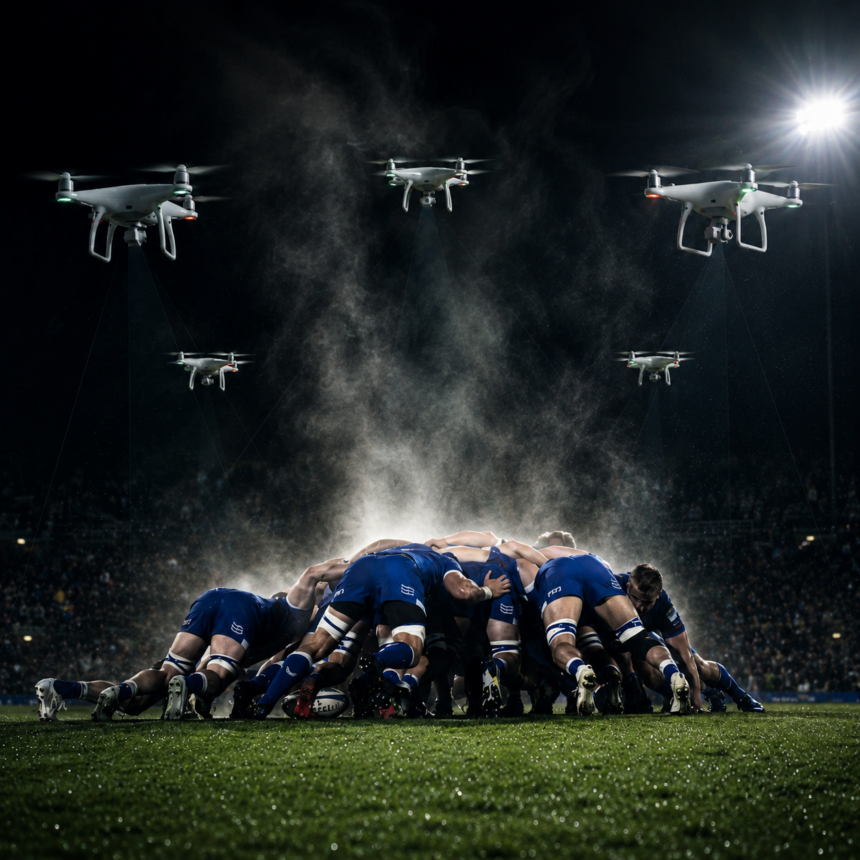
Picture this: it’s 2035, and the air above a packed stadium doesn’t just carry the roar of the crowd—it hums with the quiet presence of autonomous drones. Below, in the mud and chaos of a ruck, there’s no referee in a yellow shirt, no TMO booth, no collective groan when a try is disallowed for a foot in touch that no one saw. There’s only the game—pure, unbroken, and judged by an invisible, omniscient eye.
This isn’t science fiction. It’s the logical, if radical, endpoint of a trajectory rugby has been on for decades. The question is no longer if technology will transform officiating, but whether we’ll have the courage to let it finish the job.
The Problem: Human Error in a Hyper-Analyzed Age
Rugby has always been a game of fine margins, but never before have those margins been so scrutinized. The modern game is a high-speed collision of athleticism and strategy, yet its outcomes are still decided by the fallible human eye. Recent controversies have laid this bare. In the 2026 Six Nations, a single TMO intervention in the England-France finale sparked outrage, with former referee Nigel Owens admitting the protocol was not followed correctly. Coaches and pundits alike have been vocal: matches are being decided by officials, not players.
The data supports them. A 2025 analysis of AI-enhanced officiating noted that human accuracy on offside violations sits at a mere 45%, while computer vision can achieve 98%. At the breakdown, the most complex and contested area of the game, human error rates exceed 70%. When a sin-bin can cost a team an average of two tries, the stakes of a missed call are higher than ever.
The frustration is palpable. Fans watch in real-time as a referee misses a clear infringement, only to see the same moment replayed in slow motion seconds later. The disconnect between what is seen and what is called has never been wider. In an era where every tackle, pass, and ruck can be analyzed frame by frame, the reliance on human judgment alone feels increasingly archaic.
The Solution: A Silent, Sweeping Technological Takeover
The building blocks are already in place. World Rugby’s new remote TMO hub, operational by 2026, gives officials access to every camera angle independent of the broadcast feed, a move designed to improve speed and consistency. Hawk-Eye’s technology, long a staple in tennis and cricket, is being integrated to provide split-screen and zoom functionality for officials.
But the next phase is where the game changes fundamentally. AI-powered computer vision can track player positions, ball velocity, and body contact points in real-time. Smart ball technology, already being trialed, tracks the ball’s position 20 times per second, making forward pass and touch-line decisions objective and instantaneous.
The commercial imperative is undeniable. Broadcasters are already investing heavily in immersive technology. The 2026 FIFA World Cup will feature “referee view” cameras and AI-stabilized shots, a trend that will inevitably cross over to rugby. Drones and spider-cams offer dynamic, cinematic footage that traditional sideline cameras cannot match, increasing the value of broadcast rights and fan engagement. A game officiated by AI would be faster, with fewer stoppages, making it a more attractive product for a global audience accustomed to the seamless flow of the NFL or NBA.
For RugbyRapt and SportsRapt, this represents a new frontier in storytelling. Imagine the footage: drones hovering above the scrum, capturing angles never before seen, feeding live data streams that enhance the viewer’s understanding of every decision. The commercial value is immense—sponsors will pay premium rates for access to this data, and broadcasters will craft narratives around the technology itself.
The Vision: A Game Unbound
So, what does the future look like? It’s a game where drones float silently above the scrum, their sensors tracking every inch of space. There are no referees on the field, only players. The “whistle” is a haptic pulse in a player’s wristband, signaling an infringement detected by the AI network. Penalties are taken quickly, without debate. The TMO is a cloud-based algorithm, processing thousands of data points per second to make decisions in milliseconds.
This future is not without its perils. The “wild flair” of rugby—the spontaneous, chaotic moments that define the sport—could be curtailed by a hyper-structured, formalized system. The human element, the ability of a referee to manage a game’s temperature with a well-timed word or a lenient call, would be lost. Rugby has always been a game of emotion, of momentum shifts dictated not just by skill but by the psychological interplay between players and officials. Remove that, and you risk creating a sterile, mechanical version of the sport.
Yet, the alternative is a game increasingly paralyzed by its own complexity. The current system, with its reliance on human interpretation of ever-more-detailed laws, is unsustainable. The future of rugby officiating is not about replacing referees with robots; it’s about empowering the game with a level of fairness and accuracy that humans can never achieve.
The question for World Rugby, the unions, and the fans is simple: do we value the romantic ideal of the human referee more than the integrity of the contest itself? The technology is ready. The only thing left to decide is whether we are.
This editorial is published simultaneously on SportsRapt and RugbyRapt, exploring the intersection of technology, tradition, and the future of rugby.