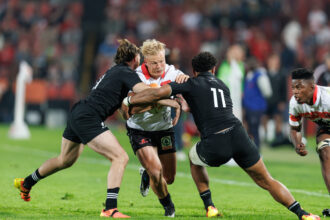



South Africa 33–26 New Zealand: The Boks got the victory they desperately needed in Cape Town. But beneath the scoreboard was a warning Rassie Erasmus cannot ignore — the All Blacks are beginning to play a different kind of rugby.
The Springboks won.
That is the statistic that matters tonight.
South Africa beat New Zealand 33–26 at DHL Stadium in Cape Town, levelled the Greatest Rivalry series and produced the response Rassie Erasmus demanded after the 33–16 defeat at Ellis Park.
But strip away the emotion, the flags and the seven-point winning margin, and another story begins to emerge.
The Springboks looked heavy-legged. The All Blacks looked evolutionary.
New Zealand scored four tries to South Africa’s three. South Africa’s decisive scoring advantage came from Cheslin Kolbe’s boot: four penalty goals, three conversions and 18 points in total. Every New Zealand point came through tries and conversions.
That doesn’t make the Bok victory undeserved.
It does make it fascinating.
Because rugby may be standing at the beginning of a tactical shift.
The All Blacks Don’t Want to Give You the Ball
For years, modern Test rugby has increasingly rewarded teams capable of dominating without necessarily possessing the ball.
South Africa perfected it.
Kick accurately. Chase brutally. Contest in the air. Squeeze the opposition territorially. Build a monstrous pack. Force errors. Win penalties. Turn the match into a physical examination the opposition eventually fails.
It has produced back-to-back World Cups.
But New Zealand appear to be asking a different question:
What happens if we simply refuse to give you the ball?
There were periods in Cape Town when the All Blacks seemed almost liberated by possession.
They went through double-digit phases before halftime. Early in the second half they constructed another attack of around 15 phases. Later, with South Africa attempting to squeeze them through territory, New Zealand kept sniping, passing, stepping and using short connections around defenders.
Not everything worked.
That is important.
South Africa’s defence was outstanding at times. The All Blacks occasionally travelled sideways rather than forwards. But they did not appear psychologically uncomfortable having to retain the ball.
Quite the opposite.
The longer New Zealand held it, the more dangerous they appeared.
Every Box Kick Carries a Warning
Perhaps the most revealing moment came before Leroy Carter’s try.
South Africa kicked.
Will Jordan fielded it.
And within seconds New Zealand exploded from right to left, shifted the point of attack and released Carter down the touchline.
Try.
That is the danger.
Against ordinary teams, a well-directed box kick creates pressure.
Against New Zealand, an inaccurate one can become an attacking assist.
The Guardian’s live analysis actually noted an intriguing tactical distinction in the first half: New Zealand were gaining territory by kicking long, while South Africa were going higher and shorter, searching for the aerial contest.
So this is not an argument against kicking.
It is an argument against predictable kicking.
New Zealand kicked too. But increasingly they appeared to kick with a destination in mind.
South Africa too often appeared to kick because kicking remains part of the system.
There is a difference.

Malcolm Marx Saved South Africa From Something Bigger
Then there was Malcolm Marx.
If you want to understand why South Africa survived some of New Zealand’s most dangerous passages, look at him.
Marx destroyed one promising All Blacks attack with a huge intervention before halftime. Around the 50-minute mark he produced another breakdown steal. Then, with New Zealand threatening again in the 71st minute, Marx ripped possession away from Damian McKenzie.
Kolbe kicked the resulting penalty.
33–19.
Those are championship moments from a championship player.
But there is another way of looking at them.
South Africa required moments of exceptional individual breakdown brilliance to stop a New Zealand side that simply kept coming.
That should concern Erasmus.
The Heavyweight Question
The Springbok philosophy is built around power.
Big forwards.
Big collisions.
Set-piece pressure.
A replacement bench designed to make the final quarter physically intolerable.
But what happens when the opposition refuses to continually run directly into that power?
What happens when they shift the point of contact?
What happens when forwards have to reload laterally again and again?
What happens after 10 phases?
Fifteen?
Twenty?
Suddenly, size has a cost.
The All Blacks are attempting to make defenders move before they make them tackle.
And that could represent one of rugby’s next great tactical evolutions.
It is not about reckless running rugby.
It is about possession with movement.
Keep the ball alive. Move defenders. Use forwards as passers. Attack shoulders rather than bodies. Change direction. Stretch the field. Then accelerate when the defensive picture finally breaks.
New Zealand’s four tries in Cape Town are evidence that the philosophy carries teeth.
Rassie Has a Year to Answer the Question
Nobody should write off Rassie Erasmus.
That would be foolish.
He has reinvented South African rugby before and possesses extraordinary depth, intelligence and tactical courage.
But the warning lights are flashing.
If South Africa arrive at the 2027 Rugby World Cup believing that size, box kicks, aerial contests, scrum penalties and defensive pressure alone will carry them to a third successive title, they may discover that rugby has moved while they were defending the old kingdom.
The Springboks won in Cape Town.
Celebrate it.
They needed it.
But New Zealand scored more tries, kept returning from seemingly impossible positions and repeatedly demonstrated that possession does not frighten them.
It feeds them.
And that may ultimately be the biggest lesson from Cape Town.
South Africa won the Test.
But New Zealand may have won the argument.