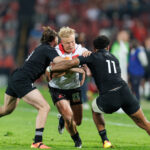




When the All Blacks walked off the pitch at Ellis Park with a commanding 33–16 victory, the rugby world reflexively drew its usual conclusions. Five tries to one. Dominant in physical collisions. A statement win that signaled New Zealand’s return to the absolute summit. But deep historical analysis sends a far more ominous warning: beating South Africa ahead of a Rugby World Cup is the single most unreliable metric in global sport.
In fact, modern rugby history suggests a far more unsettling paradox. Defeating the Springboks early doesn’t establish dominance—it merely unlocks their most dangerous evolution.
Look back across the World Cup era, and the pattern transforms from an anomaly into an iron law. The narrative that early dominance translates to World Cup glory collapses the moment you examine South Africa’s championship triumphs.
The 2007 Mirage Before the 2007 tournament in France, New Zealand systematically dismantled South Africa twice. They secured a tight 26–21 victory in Durban, followed by a 33–6 hammering in Christchurch. Aggregate score: 59–27 to the All Blacks. The narrative was written; New Zealand were untouchable. Yet months later, the All Blacks suffered their worst early exit in history against France in the quarter-finals, while South Africa marched on to lift the Webb Ellis Cup in Paris.
The 2019 Misdirection Twelve years later, the phenomenon repeated itself—this time inside the tournament itself. Opening weekend in Yokohama saw New Zealand outclass South Africa 23–13. Pundits declared the All Blacks had established complete psychological superiority over their arch-rivals. Six weeks later, while New Zealand were packing their bags after a semi-final defeat to England, Siya Kolisi was lifting the trophy after blowing that same English team off the park 32–12.
The 2023 Reversal By 2023, the trend was undeniable. New Zealand blew the Springboks off the field in Auckland with a breathless 35–20 victory, leading 20–3 at halftime. The reaction was immediate: New Zealand had solved the South African puzzle. What followed was a masterclass in Springbok adaptation. Just six weeks later at Twickenham, South Africa handed the All Blacks a record 35–7 defeat—the heaviest loss in New Zealand’s history. Two months after that, under the lights at Stade de France, South Africa edged the final 12–11 to become the first nation to capture four World Cups.
The Springbok Machinery: Across three World Cup cycles, New Zealand recorded emphatic victories over South Africa in the World Cup year. South Africa won two of those World Cups; New Zealand won just one. Add 1995—when South Africa took the crown without losing to NZ prior—and three of the Springboks’ four titles came in years where the All Blacks had either beaten them early or beaten them in pool play.
Why does this happen? The Springbok ecosystem operates on a distinct timing cycle. Early-cycle or mid-season losses serve as diagnostic telemetry rather than devastating blows. A South African defeat to New Zealand isn’t a crisis; it is structural data. It feeds their tactical adjustments, refines their squad depth, and provides the ultimate psychological catalyst: an ironclad siege mentality.
The All Blacks, by contrast, carry the burden of perfection with every Test victory. A 33–16 triumph at Ellis Park offers immediate satisfaction, but history proves it yields zero interest when the World Cup is on the line. It validates current execution without testing a team’s capacity to adapt under ultimate pressure.
BEAT THE BOKS AT YOUR PERIL:
The Extraordinary World Cup Statistic New Zealand Shouldn’t Ignore
2007: NZ beat SA twice → Boks World Champions
2019: NZ beat SA at the World Cup → Boks World Champions
2023: NZ beat SA 35–20 → Boks World Champions
2026: NZ beat SA 33–16 → 2027 ???
This isn’t to say South Africa’s defeat was intentional, nor does it guarantee a repeat of history. Causation is not the argument here. But historical precedent is loud, clear, and uncompromising.
Celebrating an early victory over the Springboks is like poking a sleeping giant—it might feel satisfying in the moment, but all you’ve really done is ensure it wakes up hungry. For the All Blacks and the rest of the rugby world, the historical lesson is unmistakable: beat the Boks at your peril.